
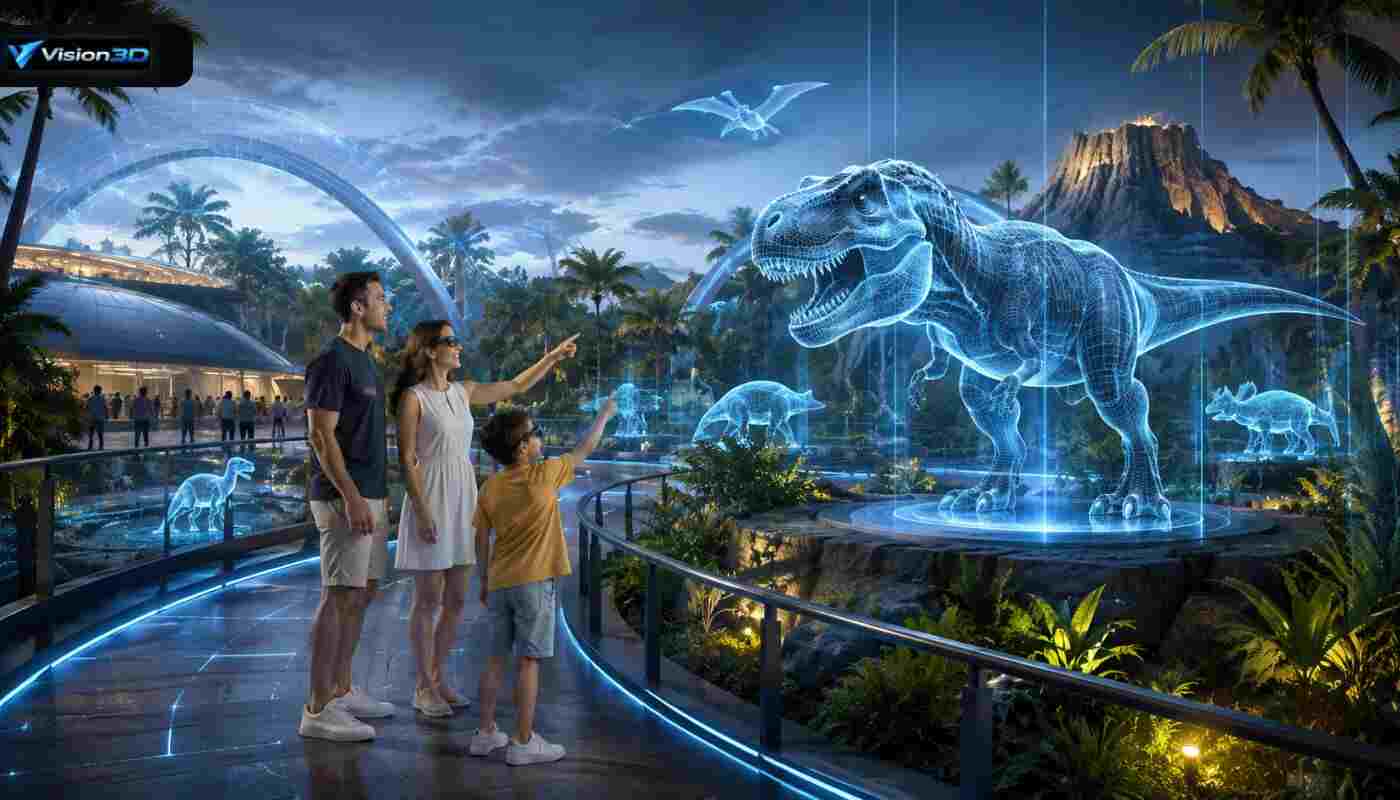
A Hologram in Theme Park gives an experience meant to turn traditional rides as well as shows into immersive 3D spectacles by projecting lifelike, seemingly floating characters and environments around the guest. Parks no longer rely exclusively on animatronics, screens, or pyrotechnics. The use of a complex projection and optical‑trick setup makes avatars appear to reside within a real‑world space. These experiences rapidly combine storytelling, show engineering, and high‑end visuals to create theme-park moments perhaps more cinematic and futuristic than classic attractions.
The Concept of Holographic Theme Park Experience
A hologram in a theme park experience refers to a theme attraction—usually a show, walkthrough, or ride segment—in which the 3D images seem to exist within physical space, easily seen without 3D glasses. The holographic projections may be:
1. Background environments (e.g., floating castles, star fields, or cityscapes).
2. Character avatars that “talk” to guests or perform choreographed routines.
Interactivity that responds to sound, movement, or guest choices.
Increasingly now, theme parks are beginning to package these features into digital theme park experiences. In these parks, guests can experience a holographic show or a holographic character in the ride itself and the apps or AR areas.
How Holography Works in a Theme Park Environment?
Holograms in theme parks are ordinarily not genuine or scientific holograms but rather advanced projection and optical‑trick arrangements. The common techniques are as follows:
- Reflecting Pepper’s Ghost–style exhibits: These display a slanted transparent screen or glass so that the high-brightness projector image reflects through it. It makes the 3D object appear to float in front of or inside a physical set.
- Volumetric displays: Light is swept by lasers or LEDs through rotating or layered media, ultimately forming a 3D shape (slice-by-slice) that the eye sees as an object.
- Holography laser projection: Users can control holographic laser projection through a diffused or aerosol‑filled space, producing short-lived glowing trails that gather to make a 3D spectacle.
The content of these presentations actually dictates how everything will go: lighting and, oftentimes, sound can move holographic images in time with the narrative of the show.
Applications of Holograms in Theme Parks
Theme parks worldwide are surreptitiously emitting holograms in Theme Park attractions into their arena:
- Character meet-and-greet holograms: A living or fictional character may appear as a 3D avatar standing right beside this brain‑smashing creation of great customization, with prerecorded speech or animation exchange with guests.
- Holographic stage shows: Dance, light, and holography acts replace or offset the normal stage performance for a more futuristic concert or spectacle hipness.
- Interactive walkthroughs: Guests walk through a reality where holographic creatures, cars, or shaped contents move in response to their movement through motion‑sensor systems.
This application improves the storyline, allowing parks to develop characters or scenes in places too big, dangerous, or too costly for actual actors who are too heavy to play such a scene.
This table, in essence, delineates how different developed and developing infrastructure scenarios provide 3D Hologram entertainment in the digital age of a theme park.
Pros and Cons of Holograms in Theme Parks
Pros :
A hologram experience in a theme park has many advantages, including:
- A huge “wow” factor that could drag in a new flock of instant social media visitors.
- Viewers will experience Less wear and tear compared to animatronics.
Cons :
Content updates are flexible, with new characters, effects, and plots through software upgrades. But, obviously, as with everything else, holograms pose a few challenges.
- Bright ambient light could wash out holographic images, which means the user would need careful lighting design in the process.
- If the projection angles are not right, the illusion may seem to be bigger than the entire hologram, as a matter of fact.
- Maintenance and calibration need skilled technicians.
The difficulties notwithstanding, as the equipment becomes smaller, more efficient, and easier to integrate into rides.
It makes more equipment available for use in show buildings and engineering conditions. It makes interest in the Hologram in Theme Parks intensify.
FAQs
Ans. An attraction that employs 3D holographic‑like technology, projection systems meant to create illusions of seemingly three‑dimensional scenes or characters.
Ans. An actual hologram seems to float in space and can be visible from multiple angles unlike regular video.
Ans.Yes. Many parks use holographic shows in association with a few augmented reality apps.