
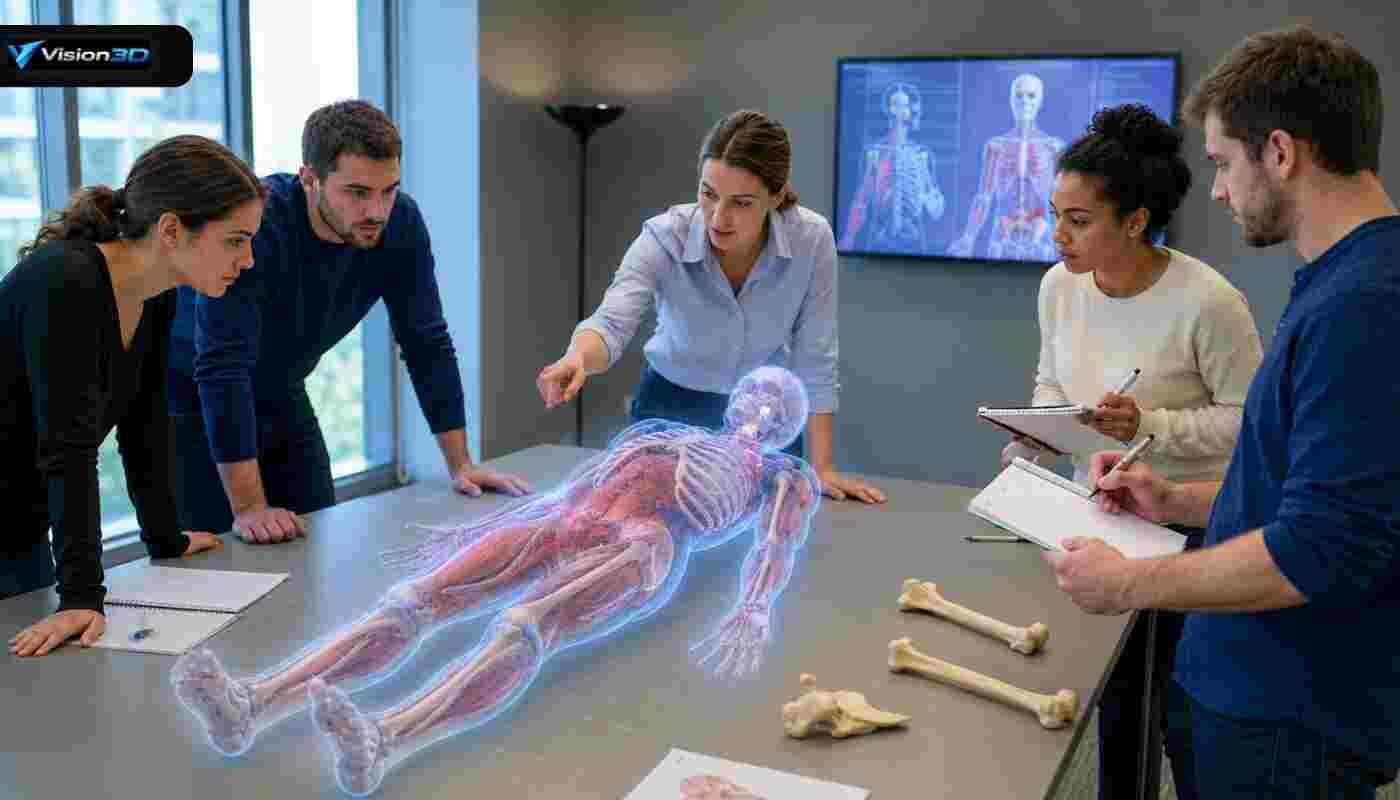
3D hologram training changes the usual classroom kind of approach by making learning feel immersive and interactive, so students and employees can practice hard skills without real-life danger. Instead of just absorbing facts from textbooks or staring at 2D videos, learners step into life-sized 3D projections that they can spin, nudge, and investigate from different views. These modern 3D hologram training platforms are used in healthcare, aviation, engineering, and business settings, and they tend to show clear gains in knowledge, staying power, and on-the-job readiness.
How 3D Hologram Training Works?
Holographic screen technology projects volumetric visuals through LED fans, laser projectors, or light-field displays, visible without glasses. People interact using voice commands, gestures, or touch panels, so virtual objects move instantly as they manipulate them. When you blend it with AI, AR, or VR, the training becomes more individualized, adapting the difficulty level as performance shifts, even when the pace is uneven.
Applications Across Industries
Healthcare and medical training
Medical students practice operations on hologram-based simulations of human anatomy, walking through organs, bones, and vasculature from every angle. Trainees repeat procedures without any patient risk, which boosts confidence and helps cut errors by 30-40%. In emergency response rehearsals, critical scenarios are played out in a controlled way, without putting lives in danger.
Aviation and engineering
Pilots train inside cockpit replicas, with instrument panels showing up as if they are floating control pieces. Engineers crawl into the innards of machines, breaking components apart in a simulated manner so they understand how things work and what requires attention. Aircraft maintenance teams walk through complicated sequences ahead of time, before they touch the real equipment, in the field.
Corporate training and onboarding
3D hologram training helps employees get started sooner, through interactive product presentations, safety routines, and leadership coaching. Instead of having one meeting room, virtual classrooms with hologram tutors run the sessions across several locations . For soft skills work, conversational AI holograms guide rehearsal conversations, like role-playing scenes that look far more lifelike than expected sometimes.
Key benefits of the 3D Hologram Training Solution for organizations
With 3D hologram training, knowledge retention can improve by 75% compared to traditional approaches because people absorb information through several senses at once. Trainees can practice again and again without using physical resources and without triggering safety concerns. Remote access also supports global teams, so they learn together. Over time, organizations often see durable cost savings, mainly from less travel, reduced equipment wear, and fewer training handouts or materials.
A hologram provider typically partners with organizations to adjust the content, so the training stays aligned with specific industries and day-to-day operational requirements.
Implementation and ROI Considerations
Most 3D Hologram training rollouts begin as pilot programs, before they go full-scale later. Many organizations report ROI from multiple angles: about 40% quicker training completion, roughly 30% less equipment damage, and noticeable gains. If you rent a hologram device system first, it becomes a practical way to test outcomes before signing a purchase agreement.
Wrap Up!
3D hologram training ramps up involvement and know-how across a whole range of learning settings, not just one narrow lane. Organizations get a competitive edge from having a more skilled team, and they also tend to notice training costs going down. A good first step is a small pilot effort, and then you collaborate with experienced service providers to shape bespoke modules. After that, you can roll it out in steps by reviewing real outcomes. Today’s 3D hologram training is also moving toward a future where learning feels more effective, more engaging, and more secure, without the same old friction.