
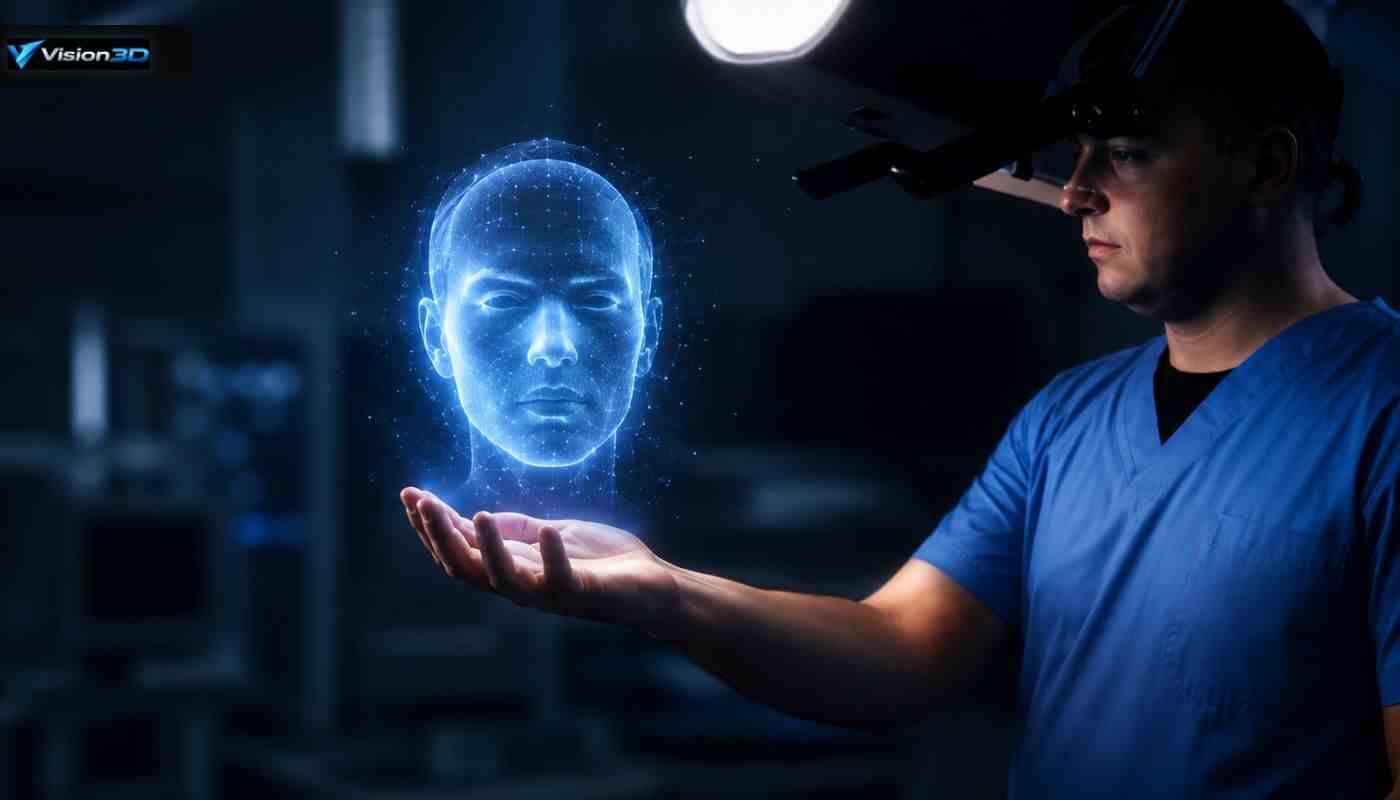
The new generation of holographic technology is transforming medicine with better training, planning, and patient care. From the perspective of healthcare, Hologram has made it possible for doctors to see anatomy and disease in 3D, speeding up diagnosis and decreasing mistakes. Hospitals can train their staff faster, personalise treatments, and create better outcomes across specialties when combined with digital twin in healthcare modeling and immersive 3D hologram learning experience.
Why Holograms Matter for Patient Outcomes.
In traditional 2D imaging, clinicians have to mentally identify complex anatomy. A 3D hologram provides a clear picture of spatial relationships and eliminates the cognitive load or misinterpretation. Surgeons are able to practice surgery on life-like holograms of patients’ organs. The accuracy, efficiency, and reduction in complications during this rehearsal are benefits to patient health and recovery.
Digital Twin in Healthcare: Personalized, Predictive Care
In healthcare, a digital twin constitutes a virtual dynamic model of a patient’s physiological characteristics, combining imaging, monitoring, and medical history. A digital twin is a virtual copy of a patient that allows physicians to simulate procedures, predict outcomes, and personalize care. Predictive modelling aids the identification of risks and prevents complications before they occur, which leads to better care pathways and reduced readmissions.
Enhancing Clinical Training with 3D Hologram Learning
The hologram training revolutionizes the field of medical education by providing a safe and repeatable environment for practice without the risk of harm to patients. The 3D hologram learning technology allows students and residents to immerse themselves in an anatomical layer, to rehearse procedural steps, and to have objective performance feedback. Training is scalable: Institutions can standardise learning without compromising hands-on realism, reducing the learning curve, and creating more competent clinicians.
Applications across care settings:
- Surgical planning: When complex surgery is required, the pre-operative hologram will enable the surgeon to know the exact tumor boundary, the vessels, and the angle of implantation.
- Rehabilitation and therapy: Holographic feedback plays a part in the rehabilitation of stroke patients and orthopedic patients, providing more active and more realistic motor training.
- Holographic models: When clinicians demonstrate the holographic models, patients will understand their diagnosis and treatment options better, and informed consent and patient satisfaction will improve.
Operational Benefits and Cost-Effectiveness
Although holographic systems and digital twin setups require a high initial investment, they offer strong long-term benefits. These technologies help reduce procedure time, lower complication costs, and minimize unnecessary testing. Hologram training also decreases the need for expensive simulation labs and cadaver-based programs. Over time, better efficiency and improved patient outcomes help recover the initial costs.
Implementation best practices:
- Targeted pilots: Run pilots of hologram training, and track results in one department.
- Integrate data sources: so imaging, EHRs, and monitoring systems connect smoothly in practice, not just in theory. That way, the digital twins actually mirror the patient’s current state, in real time, without lag, and with a kind of continuous sense of what’s happening.
- Train the trainers: Train clinical educators, both technically & in terms of curriculum design, and train them to be effective in 3D hologram education.
- Provide tracking: Procedure times, complications, and readmissions, trainee competency, etc., to demonstrate ROI.
Ethical and Regulatory Considerations
Implement Secure De-Identification and Data Governance Processes to protect patient privacy when developing a digital twin. Clinically validate holographic tools and adhere to local regulatory guidelines for use. The well-defined procedures and oversight of the clinicians ensure that hologram in healthcare enhances patient care while remaining safe and ethical.
Final words
Advanced hologram in healthcare and digital twin in healthcare are transforming modern medical services. These technologies improve clinical decisions, medical training, and patient interaction. 3D hologram learning and customized hologram training help healthcare providers improve accuracy, reduce risks, and provide better patient care. To learn more about holograms in healthcare, contact Vision3D today.
FAQs
Digital twin helps doctors predict treatment results and create personalized care plans for patients.
3D hologram learning uses immersive holographic models to teach anatomy and medical procedures more effectively than traditional 2D methods.
Hologram training helps clinicians and students practice medical procedures and decision-making in a safe and realistic environment.