
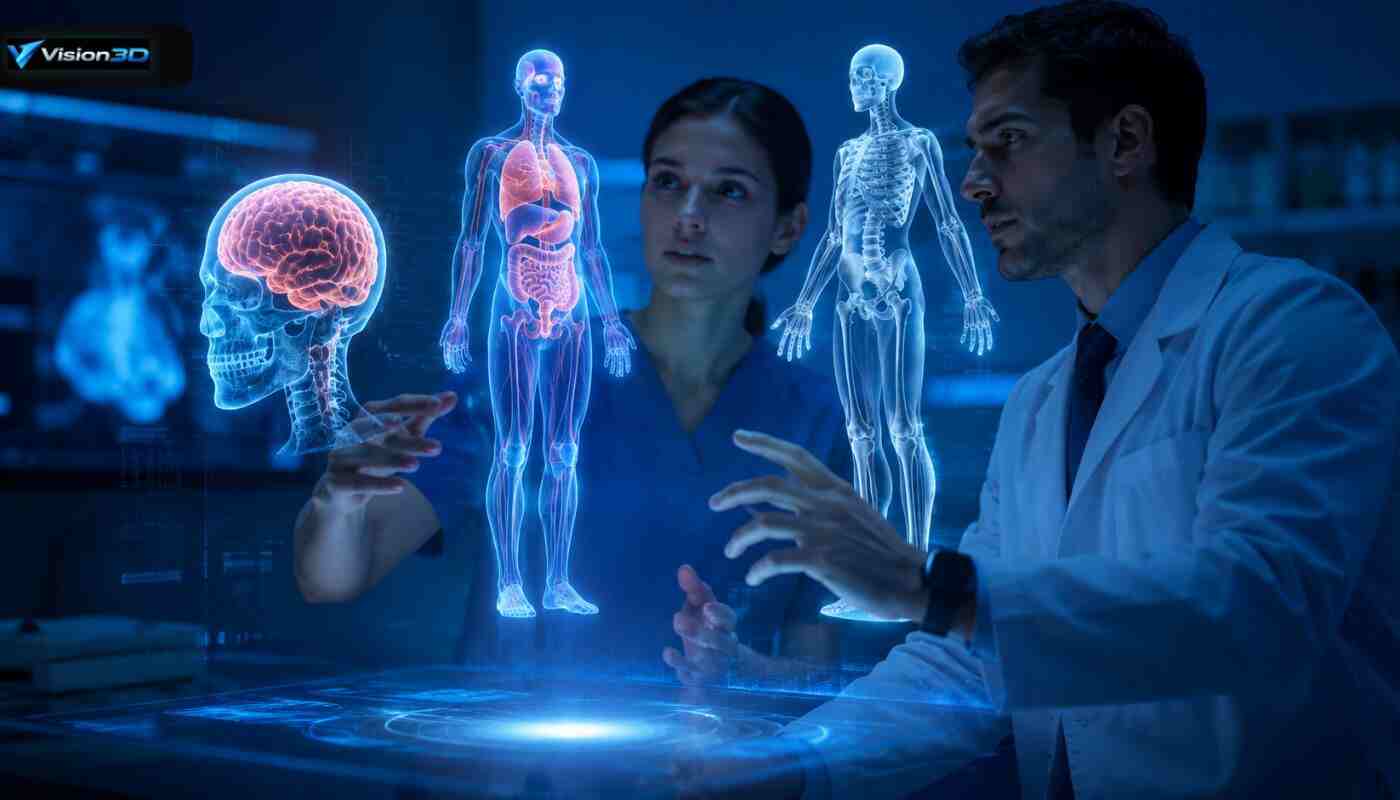
Hologram devices in healthcare present a new way to deliver presentations through their capacity to create immersive 3D visual displays, which transform complex medical data into accessible interactive content. These tools make hologram presentations much higher than the conventional slide method. In 3D hologram healthcare, it can be used for precise planning, education, and patient engagement.
What Are Hologram Devices?
A hologram device uses light interference to create full 3-D details in the image, without glasses, that can be seen from any angle. They turn 2D medical scans into dynamic hologram projection models of organs, tissues, or entire anatomies in 3D hologram healthcare. The hologram presentation technology makes it possible for professionals to turn static data into interactive experiences by rotating, zooming, and dissecting visuals in real-time during consultations, surgeries, or training sessions.
Key Benefits in Surgical Planning
Hologram presentations improve preoperative planning by allowing surgeons to view patient-specific 3D models created from CT or MRI scans. Doctors can examine organs, tissues, and hidden anatomies in detail before surgery. Medical teams can also simulate procedures, choose safer incision paths, and reduce surgical risks by up to 30%.
In complex surgeries such as cardiac or neurosurgery, hologram projections help doctors locate tumors near vital organs more accurately. This technology can shorten surgery time, improve precision, and support better patient outcomes. It also helps surgeons build confidence and avoid unexpected complications during procedures.
Advancements in Diagnostics
Hologram devices provide more accuracy to diagnostics in that 3D hologram healthcare projections show anomalies that are not seen in 2D images. Radiologists turn the holograms around to view them from various angles, which speeds up the process of making reliable diagnoses such as subtle fractures, lesions, infections, and more.
Overlays with different datasets for multidisciplinary reviews and pattern detection, such as disease progression, are possible with hologram presentation. This efficiency optimizes hospital processes and ensures accurate diagnosis.
Enhancing Patient Education
Hologram projection is a means of communication that eliminates communication gaps in patient interaction by using holograms customized to each patient. A doctor may show the patient their pulsating heart hologram to help them understand what is happening, which can help them follow their treatment and avoid the use of medical jargon.
The patients feel empowered and feel less anxious, and are more compliant with therapy. 3D hologram healthcare bridges the gap between diagnosis and understanding, fostering trust and informed consent.
Transforming Medical Training
Educational institutions use hologram devices to improve anatomy and procedural training. Instead of relying on limited cadavers, students interact with detailed hologram projections for dissections and surgical practice. These interactive models help learners develop practical skills in a safe and controlled environment.
Hologram presentations also support scalable classrooms by allowing groups to manipulate shared 3D holograms together. Teachers can create engaging learning experiences that improve understanding and strengthen problem-solving skills. This approach prepares future healthcare professionals for real-world challenges without ethical concerns.
Telemedicine and Remote Collaboration
3D hologram healthcare extends expertise by means of hologram devices as a part of telemedicine and streaming high-fidelity projections in a distant consultation. Shared hologram projection with specialists where they interact in real-time, without travel, with rural teams. This makes high-level care accessible to everyone, allowing for accurate remote surgical procedures and diagnoses, no matter where they are.
Cost savings and scalability
Decreased error, quicker training, and fewer revisions are the starting cost benefits of investing in a hologram device. The adoption of 3D holograms in healthcare is now being expanded by portable units, which have enabled hologram presentation to be available in clinics, conferences, and homes.
Emerging Innovations
AI will be used in the future to predict models for hologram projections, including forecasts of disease outbreaks or haptic feedback for the haptic simulation. These developments hold the potential for even greater involvement in hologram presentation.
Conclusion
Hologram devices accelerate 3D hologram healthcare with unprecedented hologram projection and presentation capabilities, driving toward precision, education, and accessibility for the best health outcomes. To know more about Hologram Devices, get in touch with the Vision3D customer care number.
FAQs
Ans. They can plan in 3D and create an interactive space, reducing errors and operating time.
Ans. Anomaly detection: Multi-angle projections.
Ans. The use of personalized visualizations helps people comprehend information better, which results in improved user engagement and better compliance with established procedures.
Ans. They provide simulations that are realistic, scalable, but not real and risky.