
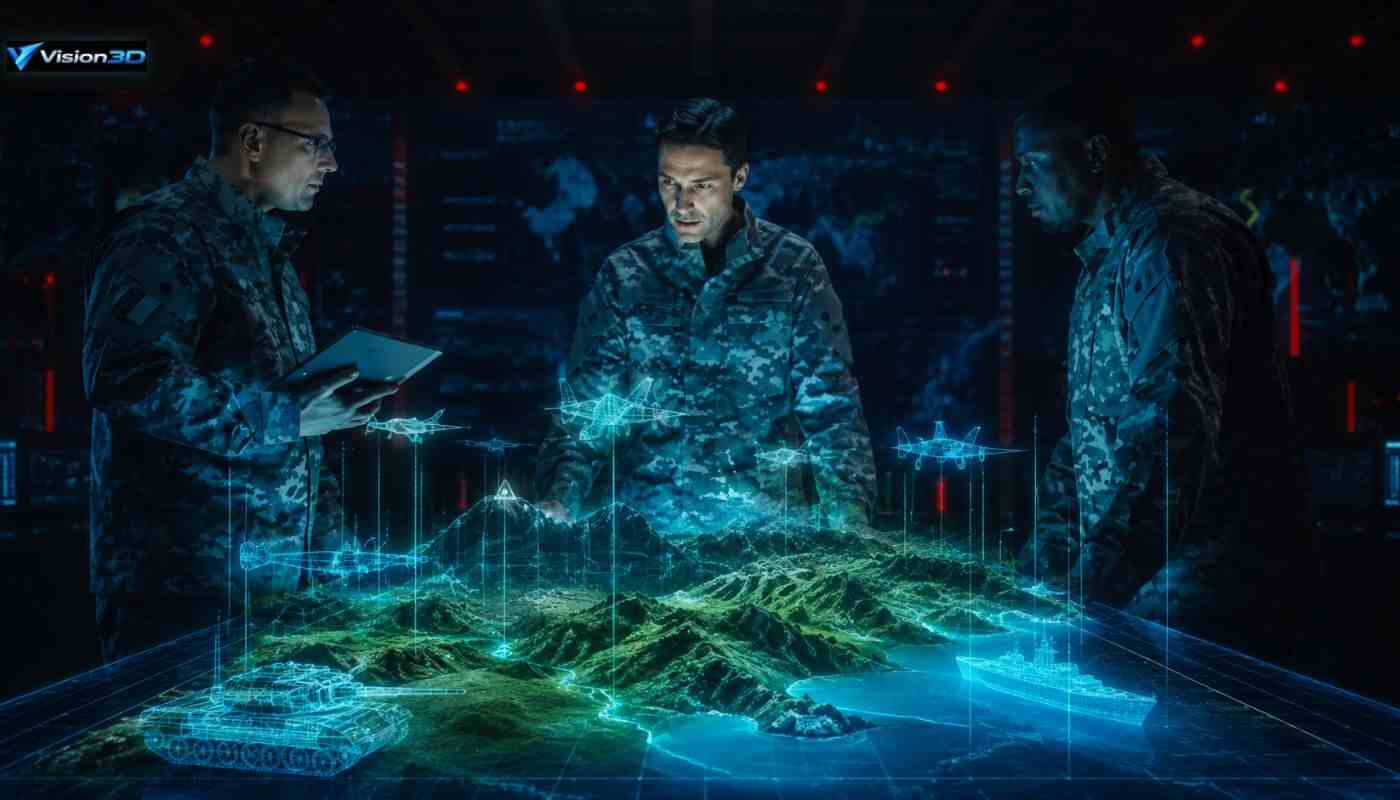
Recently, 3D hologram technology is transforming various sectors like healthcare, education and retail. However, its effect is perhaps the most profound in defence. Holographic 3D displays have shifted military operations from two-dimensional mapping to 3D visualizations, immersive training and mission planning. In the new age, 3D hologram floors, tables and walls are proving a gift for the army to execute missions and counter wars. These captivating 3D visuals offer unmatched originality, engagement and clarity to learners during combat missions. In this write-up, we make you understand how the 3D hologram in defence customizes immersive training, planning and viewing.
Is It Better to include a 3D Hologram in Defence?
Holographic military technology offers a key improvement in defence performance. It also helps the military to achieve its essential objectives during wars. With the advanced applications of 3D hologram in defence, the military department views the biggest change in training duplication, conditional understanding, and enhanced communication in the war zone. From strategic planning to training and immersive viewing through 3D holograms, the military can interpret its major targets before wars.
Immersive Military Training via 3D Holograms
3D hologram training offers the original and associative training atmospheres that duplicate and clarify the disturbance and confusion during military training without high prices or threats of live practices.
- Drone Defence Training – Holographic devices allow trainers to sense drone threats and enable them to exercise military strategies, know close flying behaviours, and how to counter unidentified objects in real-time.
- Imaginary Atmospheres – Defence soldiers can engage with the 3D hologram battleground to aim at target acquisition, positioning, and complicated maneuvers.
- Imaginary Atmospheres – Modern systems can produce three-dimensional demonstrations of terrain that enable teams to browse unrecognized regions before placement.
Mission Planning and Visualization With Holographic 3D Displays
Military commanders utilize 3D hologram displays to optimize, view, and prepare operations with great accuracy and access information with aerial, LIDAR, and radar pictures.
- Mountaineous War Area Evaluation – Defence training candidates can view the appropriate height and mountainous expansion with three-dimensional walls or screens. It is crucial for placing snipers or assessing lines of sight.
- 3D Mapping and Modelling – A complete 3D prototype of cities or defence areas allows planners to recognize possible troubles, evaluate damage, and prepare escape routes.
- Distributed Visualization – Multiple holographic tables enable up to 6 users to engage with a single and shared picture at the same time.
Features of the 3D Holographic Projector in Defence
Hologram 3D devices also have major features listed below that can be used to full capacity by military personnel.
- Multi-User Engagement – Hologram table facilitates a reactive multi-user interface that enables users to engage with 3D holo content. Military personnel can revolve, zoom, customize, and explain holographic objects through a 3D hologram explanation that improves their knowledge and evaluation of complex details.
- Engaging Association – Hologram 3D devices facilitate work atmospheres by allowing several users to engage with holographic content together. Teams can associate, think, and make informed decisions with coordinated visuals and engaging potentials.
- Real-Time 3D Representation – Holographic screens allow smooth observation of complicated data sets and duplications. For video recordings, scans, or terrain from engineering or drone prototypes, users can feel real-time holo demonstrations of their details.
- Real-Time Data Association – Holo devices associate with existing defence databases and setups. Defence staff can engage and access updated details that involve intelligence reports, complex mission data, and sensor recordings. These holo systems improve situational understanding and decision-making potential.
Final Words
The 360 hologram projector improves military visualization, training, and mission planning with immersive 3D displays. This advanced holographic technology helps defence teams understand complex battlefield situations with better clarity and accuracy. It supports faster strategic decisions and modern operational planning. To explore advanced holographic displays, contact the Vision3D customer support team.
FAQs
Ans. 3D hologram training in defence allows an improved view of difficult details like battleground holograms, real-time sensor recordings and intelligence reports.
Ans. Yes, viewers can now engage, poke, feel and touch holograms, eliminating the conventional restriction for holograms generating only light-illusions. With modern developments in 3D holographic technology, these devices use a diffuser combined with ultrasonic waves that generate a feel of a strategic barrier for audiences.