
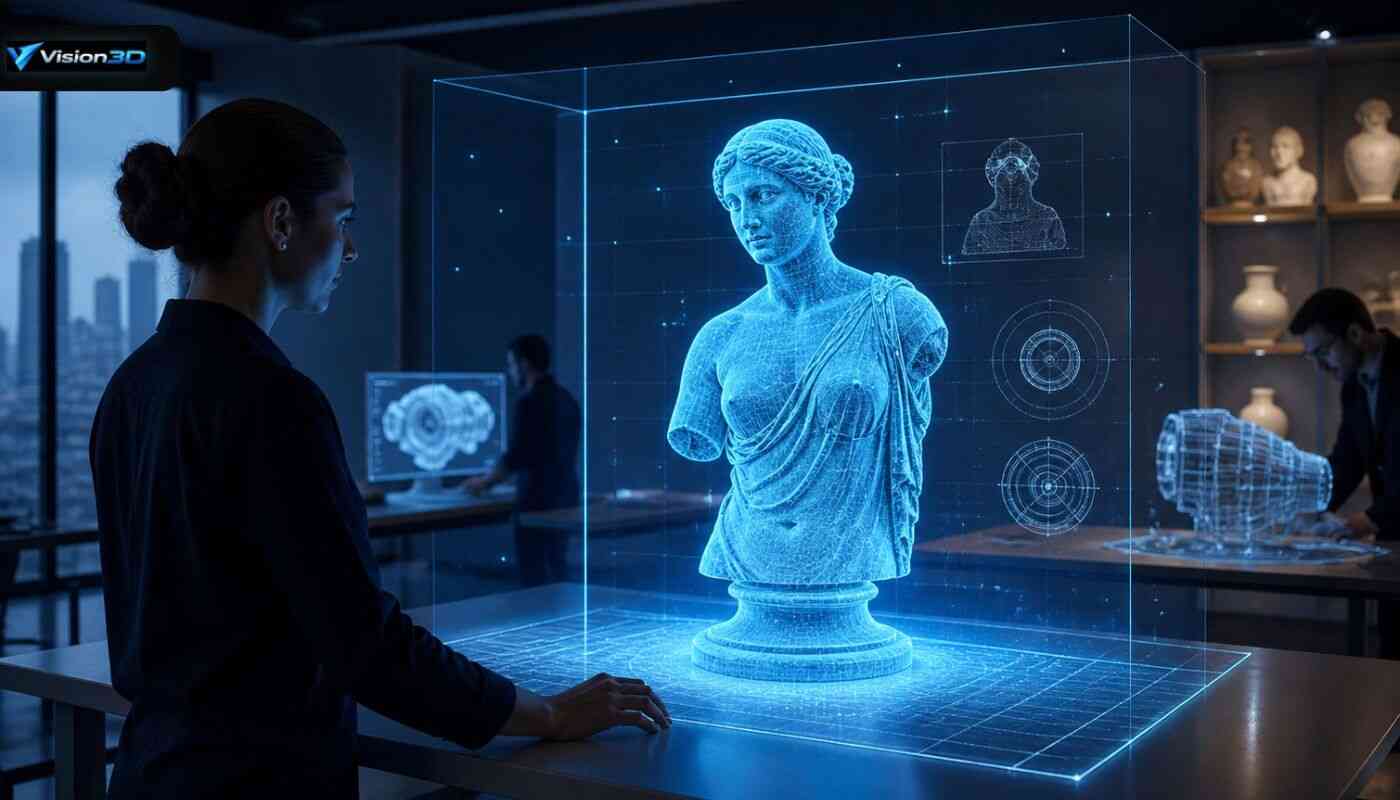
High‑Resolution 3D Digitisation has changed the way we look at artifacts from Museums, inspect structures from engineers, and Prototypes. 3D scanning and modeling translate physical articles to detailed digital twins that can help analyze, discuss, and propose modifications of antiquities and industrial items without physical contact with the original objects. This is where 3D hologram technology helps audiences understand how scanned data transforms into lifelike holographic or 3D displays, using light effects and dynamic viewing angles to create a realistic experience.
What Is High‑Resolution 3D Digitisation?
High-resolution 3D digitisation captures the exact shape, texture, and sometimes color of an artifact or environment in digital form. Professionals use advanced scanners, cameras, and software in 3D digitizing services to create accurate point clouds, meshes, and fully textured 3D models.
Key techniques are:
- 3D laser scanning: A laser beam scans across the object and measures the distance to thousands of points every second.
- LiDAR scanning: It images large-scale surroundings, e.g., buildings or terrain, and a high level of accuracy is achieved.
- Photogrammetry: The user is allowed to take Multiple photos in a grid across the object, which are then combined to make a 3D model.
After scanning, the data can be subjected to any type of analysis, measurement, simulation, or holographic visualization.
Applications in Engineering and Industrial Design
In the context of engineering and product design, the 3D scanning process actually bridges the labyrinth between digital workflows and physical prototyping. Designers and manufacturers execute the following applications with the use of scanning:
- Reverse-engineer legacy components by having the scans of the original component alongside a CAD model.
- Quality control is assessed by comparing scanned manufactured components to their respective CAD models.
- Testing fits and functions in VR before taking risks on expensive tooling and running production.
Engineers involved in infrastructure works, bridges, or mechanical works have also begun to use 3D laser scanning and LiDAR scanning technology to survey the existing structures, allowing them to plan the additional installation of equipment or retrofits into existing structures, etc., without the need for disassembly on the job site.
From 3D Model to 3D Hologram Explanation
A logical next step transforms high-resolution 3D data into a hologram or 3D rendering. In a 3D hologram workflow, developers simulate how scanned geometry projects into space and create a realistic sense of depth and volume. Computer-designed software uses light to form the image and delivers an immersive, lifelike viewing experience.
3D models from scans include:
- Apparently, they could be animated and rotated in real time on transparent screens or holographic displays.
- You can use them in mixed‑reality headsets or AR apps to overlay digital models onto physical spaces.
- Print out digitized 3D models as material replicas by using 3D printing for actual study or marketing purposes.
For any of these applications to be as real as they have to be, the whole basis of this will be in the initial accurate digitalisation, as well as the clean mesh or texture data.
Final Words
High-resolution 3D digitisation helps industries create accurate digital copies of physical objects. These models are useful for preservation, analysis, and display. Technologies like 3D laser scanning and LiDAR scanning improve accuracy and efficiency. They support museums, heritage projects, and engineering design. This leads to better decisions and immersive experiences. It also ensures data is for future use.
3D digitisation has become essential for modern industries. To learn more about the 3D hologram explanation, contact Vision3D customer care.
FAQs
Ans. High-resolution 3D digitization accurately captures physical objects as detailed digital models. Museums use it for preservation, engineers rely on it for inspection and planning, and product teams apply it to refine designs and speed up iteration.
Ans. Standard 3D laser scanning works best for small to medium-sized objects, while LiDAR scanning targets large-scale environments such as landscapes, buildings, and infrastructure projects.
Ques 3. Does the 3D hologram explanation help non‑expert laymen to understand technical models?
Ans. Yes. The 3D hologram explanation can convert complex 3D models, produced by 3D digitization services, into smoothly interactive, easy‑to‑grasp visualizations that allow a general audience to visualize and understand geometry, movement, or inner structure in a way 2D images or graphs cannot.