
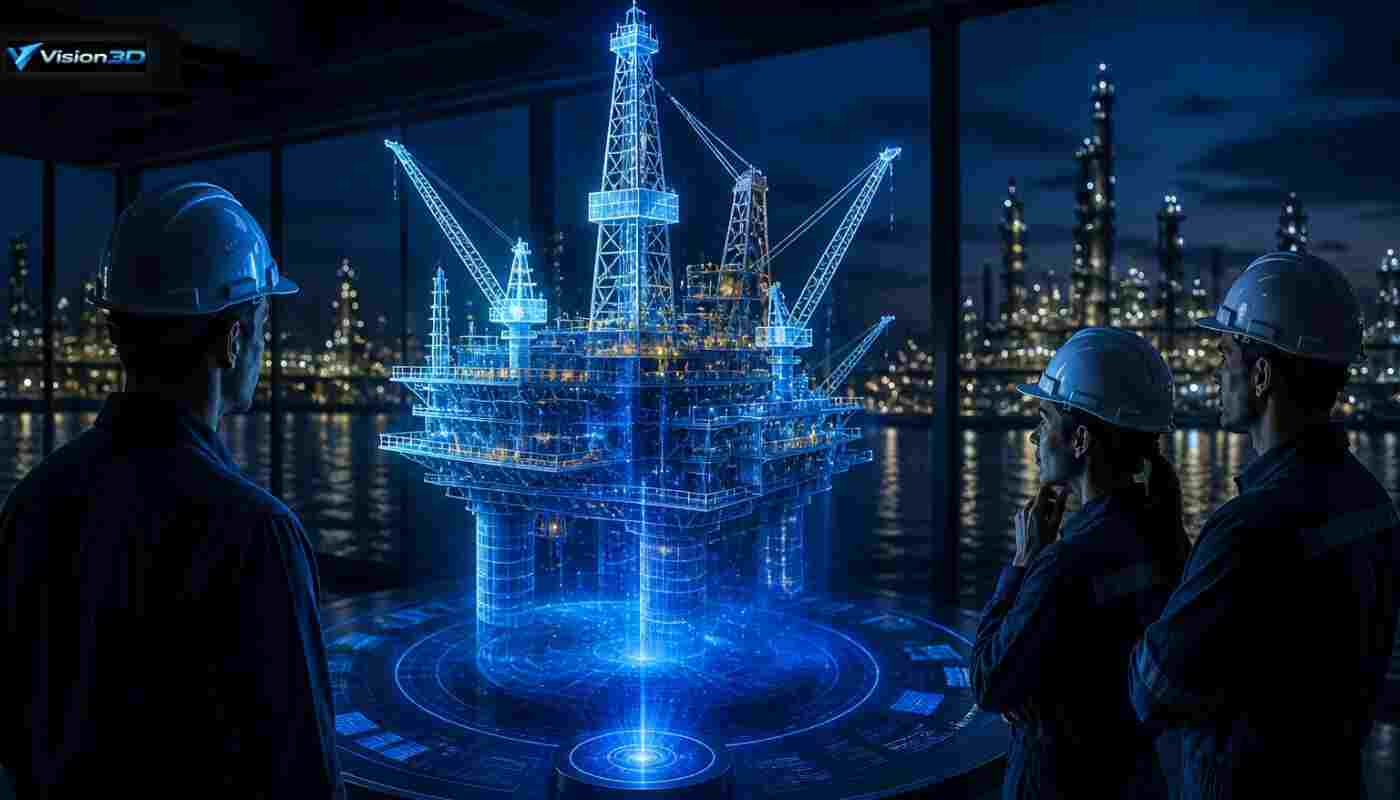
In oil and gas, a single poor drilling decision can cost millions. Hologram Projections help teams reduce risk and improve collaboration. Teams view 3D geological models, reservoir simulations, and facility layouts in a shared space. They analyze complex data visually and make faster, more accurate decisions. This approach improves planning for drilling, production, and safety.
How Hologram Projections Support Oil & Gas Workflows
Hologram Projections bring many different data sets—the layout of subsurface formations, well‑paths, and pipeline routes—into a single, interactive 3D view. This negates the need for looking at 2D maps and charts altogether, with the most experienced engineers and geological scientists able to:
- Walk around the 3D model of the reservoir to study the faults, traps, and sweet spots.
- Superimpose production data, pressure gradient data, and fluid flow simulations above the interference of the 3D layout.
- As long as distant workplaces are depicted in different dislocated parts of the world, they will be found viewing the same holographic model as a united entity in real time.
The video quality supports the notion of a digital twin oil and gas system where a 3D synchronized antigen simulation will accurately depict the real-world assets built on patented intellectual property and operational techniques.
Spotting the Peril and Identifying Opportunities
In E&P, subtle geology can either result in success or a soiled drill. Holograms enable team members to visualize patterns and anomalies on a single platform with ease, which cannot be so easily observed on conventional 2D slices or cross sections. For instance:
- Comparing seismic data with core data inside a common 3D space will provide a more accurate reservoir geometry.
- Next, drilling engineers will be able to map out multiple well‑bore paths on a holographic model, rerouting to avoid any known faults in real time.
- Production teams could juxtapose water‑flood or CO₂‑injection scenarios simulated in an oil-and-gas-simulation program that predicts some movement of fluid, shown to have taken place in a dynamic 3D animation.
By all these scenarios laid in front of them in this holographic environment, companies could make a more informed resolution without spending heavily on landwork.
Health, Safety, Training, and Facility Planning.
Hologram projections are an artificial intelligence entity system that signifies offshoring assets and onshore facilities, pipelines, and safety areas. Key tasks for the engineer are:
- Application of their 3D model to identify enclosure spots, find constrained escape routes, and detect situations where the crowding of equipment is liable to violate safety standards.
- Figure out what can be done in the finest manner for heavy equipment to pass through small spaces by developing scenarios for properly planned maintenance and decommissioning.
- Incorporate the use of 3D interactive training sessions for new recruits, which make safety drills only satisfactory with animated feedback and correct onscreen answers. This is where the concepts of holography in oil and gas—as a visualization tool—really come into play.
These activities are truly in conformity with the underlying concept of hologram in the oil and gas world as a tool for safety and operational planning in visualization.
Hologram Projection as Compared to the Other Drill
| Tool Type | Dimensionality | Collaboration | Typical Use in Oil & Gas |
|---|---|---|---|
| 2D maps and charts | 2D flat data | Limited | Basic planning, reporting |
| 3D desktop software (CAD, GIS) | 3D models | Medium | Detailed design and analysis on screen |
| Virtual Reality (VR) headsets | 3D immersive | High (single‑user or limited multi‑user) | Reservoir walkthroughs, training |
| Hologram Projections | 3D glasses‑free | High (room‑scale collaboration) | Real‑time planning, executive reviews, safety drills |
The Hologram Projection Interface bridges the gap between desktop 3D tools and VR by enabling shared, glasses-free viewing. Teams easily integrate this format into their existing boardrooms or control centers for collaborative decision-making.
FAQs
Ans. Hologram Projections allow for the imaging of reservoirs, facilities, and workflows in 3D, which enhances collaborations, reduces misinterpretation of data, and helps make safer and more profitable decisions.
Ans. Generally, a hologram in oil and gas presents a three‑dimensional representation of a digital twin oil and gas system, enabling it to synchronize real‑time or simulated data with a spatial model for monitoring, simulation, and planning.
Ans. Teams use Hologram Projections to display oil and gas simulation data—such as flow, pressure, and injection patterns—as dynamic 3D animations. These immersive visuals help teams actively inspect sites and analyze how reservoirs will behave under different scenarios before making field decisions.