
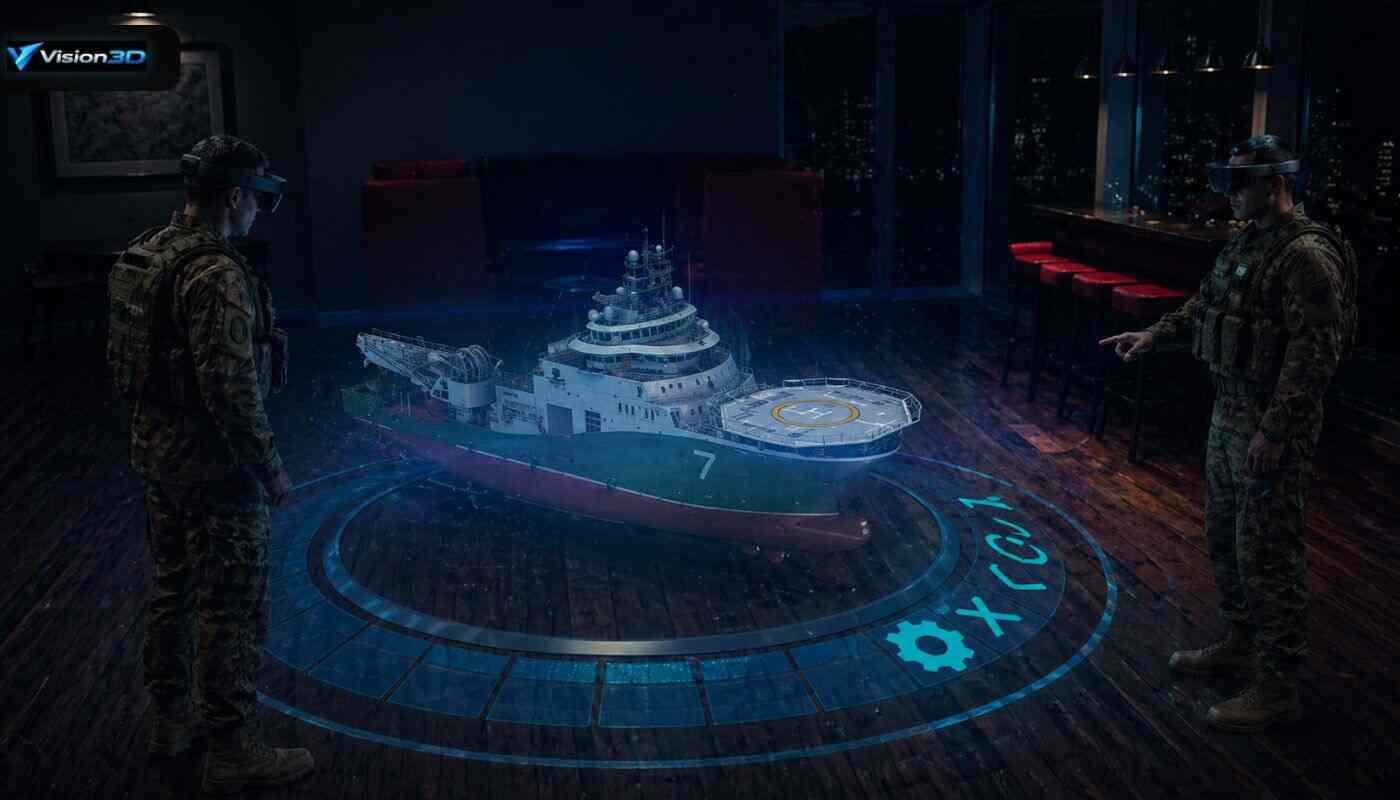
In the ever-changing seas, timely decisions are critical. But now maritime holograms are here, thanks to immersive hologram 3D visualization. Through the real-time projection of realistic, interactive 3D holograms, it takes complex data and turns it into actionable knowledge, helping shipping companies, naval fleets, and port operators control and manage maritime operations in real-time with greater accuracy.
The Power of 3D Visualization in Maritime Operations
Conventional 2D displays are not suitable in complicated maritime situations, such as the tracking of vessels or monitoring weather conditions. Holographic displays step in 3D visualization of real-time ship positions, ocean currents, and cargo loads as floating, manipulable holograms. Without lumbering software operators can stroll around a virtual fleet, zooming in on engine diagnostics or hull integrity.
It is not science fiction; it works with light-field displays and artificial intelligence-based render-engine generation of parallax effects to give the illusion of depth perception. Hologram 3D visualization superimposes radar data with satellite images in a busy shipping lane, immediately identifying collision hazards. The result? Quicker reaction, less human error, and safer trips.
Revolutionizing Hologram Maritime Simulation for Training
Training is a key pillar of maritime safety. Hologram maritime simulation takes it to the next level. It replaces traditional 2D simulators with immersive 3D environments. Crews can interact with virtual storms, rogue waves, and engine failures in real time. Ship captains use gestures to navigate through dangerous waters. Trainees also learn cargo handling with holographic models.
These simulations cut training costs by 40–50% compared to physical setups. They also improve memory through immersive learning. Naval teams use them for tactical training and strategy planning. They can simulate enemy fleet movements safely. Hologram technology in the maritime industry helps build strong skills without real-world risks.
Boosting Efficiency in the Hologram Shipping Industry
The hologram shipping business enjoys better monitoring and control. The holographic command centers visualize the supply chains around the world, monitoring the containers through the IoT sensors that are depicted as 3D networks of light. Port operators plan berthing time by simulating tidal flows and vessel maneuvers to maximize throughput.
The efficiency of fuel soars as well, and 3D visualization simulates the wind patterns and the drag of the hulls, such that a captain can vary the course in real-time. In case of an emergency, holograms indicate oil spill paths or search and rescue grids, linking responses by multiple vessels without disruption. This is expanded to deckhands with integration with AR glasses showing repair manuals on actual equipment.
Future-Proofing Maritime with Hologram Tech
The development of 5G technology, together with edge computing, will enable the implementation of immersive hologram 3D visualization systems, which will provide remote operators of autonomous vessels with complete situational awareness. The sustainability movement is advancing through the use of holograms, which enable route optimization to reduce greenhouse gas emissions. The hologram shipping industry will experience a new era of development, which combines human decision-making abilities with advanced technological capabilities.
Final Words
Maritime monitoring and control is being redefined by Immersive hologram 3D visualization, whether maritime simulation through holograms to be used by the elite or actual 3D visualization in the hologram shipping industry. It motivates safety, efficiency, and innovation in trans-oceanic. With the hologram in the maritime industry changing, the adopters will have a safer and smarter sea- there is a need to adopt it today to sail into the future. To know more about 3D Visualization, get in touch with the Vision3D customer care number.
FAQs
Ans. Supports interactive, realistic, real-time 3D image rendering on the basis of utilizing light fields.
Ans. Creates engaging, practical situations in which crews can train safely.
Ans. They add value to monitoring by making the data more accessible, converting “complex to intuitive, spatial information for a swift decision”.
Ans. Increases efficiency with accurate tracking, route optimization, and visualisation of emergency response.