
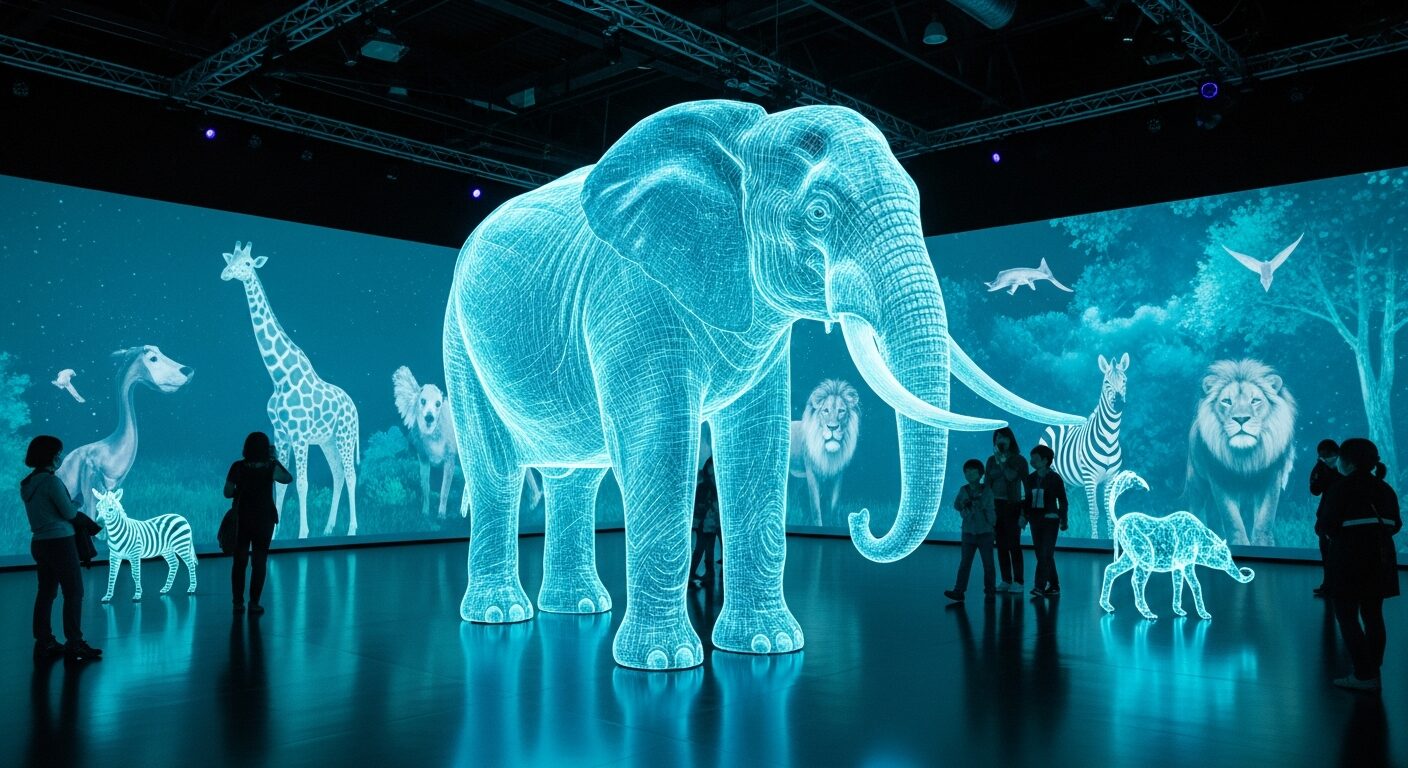
What is a Hologram Zoo?
A hologram zoo is an immersive attraction that uses holographic projection technology, spatial audio, environmental design, and interactive digital systems to present life-sized holographic animals in curated habitat environments. Visitors walk through themed zones — ocean environments, jungle landscapes, arctic tundra, prehistoric worlds — encountering holographic wildlife that moves, breathes, and interacts with the space around them.
Unlike traditional zoos that keep animals in captivity, a holographic zoo creates compelling wildlife encounters through advanced display technology. Holographic animals are rendered in photorealistic detail, projected at life scale, and animated with naturalistic behaviours. The surrounding environment — spatial audio of jungle sounds, forest projections, temperature and wind effects — creates a fully immersive experience that transports visitors into the animal's natural habitat.
The hologram zoo concept has gained significant traction globally as institutions, tourism operators, and entertainment companies seek wildlife experiences that align with growing ethical concerns about animal captivity while delivering the sense of wonder and educational value that traditional zoos have historically provided.
How Holographic Animals Are Created
Creating convincing holographic animals for a hologram zoo requires a sophisticated pipeline that combines scientific accuracy, artistic craftsmanship, and advanced display technology. The process begins with extensive research — studying real animal anatomy, movement patterns, behavioural characteristics, and habitat environments to ensure that every holographic creature is scientifically accurate and behaviourally authentic.
Digital artists create detailed 3D models of each animal using photogrammetry references, anatomical data, and high-resolution texture maps. These models capture every detail — skin textures, fur patterns, muscle structure, eye reflections, and scale details — at a fidelity level that withstands close inspection at life scale. The modelling process for a single animal species can take weeks to achieve the photorealistic quality required for a convincing holographic presentation.
Animation is equally critical. Each holographic animal is rigged with a detailed skeletal and muscular animation system that drives naturalistic movement. Lions walk with the characteristic shoulder roll and head carriage of their species. Elephants shift weight with each step. Birds fold and extend wings with anatomically accurate joint articulation. These animations are created by specialized animators who study real animal footage extensively to capture authentic motion.
The completed digital animals are then rendered for the specific holographic display system used in the installation. For large-scale hologram zoo environments, this typically means rendering content for multi-projector setups using holographic gauze, transparent screens, or Pepper's Ghost displays at very high resolutions to maintain visual fidelity at life scale. A life-sized elephant hologram, for example, requires content rendered at resolutions far exceeding standard video to maintain detail across its full surface area.
Environmental content complements the animal holograms — habitat backgrounds, vegetation, weather effects, day-night cycles, and atmospheric conditions are rendered to surround visitors with the complete ecosystem, not just the individual animals. This environmental approach is what transforms a simple holographic display into a fully immersive hologram zoo experience.
Immersive Wildlife Storytelling
A hologram zoo is not simply a collection of holographic animal displays — it is a narrative experience designed to educate, inspire, and create emotional connections between visitors and the natural world. The storytelling dimension is what elevates a holographic zoo from a technology demonstration into a meaningful visitor experience.
Each zone within a hologram zoo is designed around a narrative theme. An ocean zone might tell the story of coral reef ecosystems, taking visitors from shallow reef environments teeming with tropical fish to the deep ocean where bioluminescent creatures drift through darkness. A prehistoric zone might present the story of evolution, allowing visitors to walk among holographic dinosaurs while a narrator explains the geological and biological changes that shaped life on Earth.
Interactive elements enhance the storytelling. Visitors might trigger animal behaviours by approaching certain areas — a holographic whale breaching as visitors reach an ocean observation point, or a holographic bird of paradise performing a mating display when visitors enter a rainforest clearing. These interactive moments create personal connections and transform passive viewing into active exploration.
Educational content is woven throughout the experience. Information about species, habitats, conservation status, and ecological relationships is presented through holographic infographics, narration, and interactive touchpoints that allow visitors to explore topics at their own depth. The educational component ensures that the hologram zoo serves genuine learning objectives alongside entertainment value.
Benefits Over Traditional Zoos
The hologram zoo model offers several significant advantages over traditional zoological parks. The most immediately apparent benefit is the ethical dimension — holographic animals are not kept in captivity, do not suffer stress from confinement or visitor proximity, and do not require the complex welfare infrastructure that traditional zoos must maintain. This aligns with growing public sentiment that favours wildlife conservation over captivity.
A holographic zoo can present species that would be impossible, impractical, or irresponsible to keep in a traditional zoo setting. Visitors can encounter endangered species without any impact on wild populations. They can experience extinct animals — walking among holographic dinosaurs, woolly mammoths, or dodo birds. They can observe deep-sea creatures, polar species, or microscopic organisms — all at life scale in immersive environments. The curatorial possibilities are virtually unlimited.
Operational advantages are also significant. A hologram zoo does not require the veterinary infrastructure, feeding systems, habitat maintenance, and animal management staffing that traditional zoos demand. Content can be updated, expanded, and rotated without physical infrastructure changes — allowing the attraction to introduce new species, seasonal themes, and special exhibitions regularly, keeping the experience fresh for repeat visitors.
Geographic flexibility is another key advantage. A hologram zoo can be deployed in urban environments, shopping centres, tourism destinations, and educational institutions where a traditional zoo would be impractical. The installation footprint is flexible and can be adapted to available spaces, making holographic wildlife experiences accessible to communities that lack the land and resources for conventional zoological parks.
Weather independence ensures consistent operation regardless of climate or season. Traditional zoos are affected by weather conditions that drive animals indoors, reduce visitor comfort, and limit operating hours. A holographic zoo operates identically in all conditions, providing consistent experience quality year-round.
Applications in Tourism and Education
Tourism Attractions: Hologram zoo installations are emerging as significant tourism attractions in their own right. Cities and tourism destinations are commissioning holographic wildlife experiences as anchor attractions that drive visitor traffic, generate revenue, and position the destination as innovative and forward-thinking. The novelty and quality of the experience — combined with strong social media appeal — creates organic marketing that amplifies the attraction's reach.
Educational Institutions: Schools, universities, and science centres are adopting hologram zoo technology for educational programmes. The immersive presentation of wildlife in their natural habitats, combined with interactive educational content, creates learning experiences that significantly outperform traditional textbook and video-based biology education. Students who experience holographic wildlife encounters demonstrate higher engagement, better retention, and greater interest in conservation topics.
Conservation Awareness: Hologram zoo experiences serve as powerful platforms for conservation messaging. By presenting endangered species in their threatened habitats, showing the impact of deforestation, ocean pollution, and climate change on wildlife, and connecting visitors emotionally to animals they might never see in the wild, holographic zoos can inspire conservation action in ways that statistics and documentaries alone cannot achieve.
Accessibility: Holographic wildlife experiences can be designed with accessibility in mind — accommodating visitors with mobility challenges, sensory sensitivities, and other accessibility needs that traditional outdoor zoos often struggle to address. Controlled indoor environments, adjustable sensory levels, and accessible pathways make hologram zoo experiences genuinely inclusive.
Vision3D and Hologram Zoo Design
Vision3D designs immersive holographic wildlife experiences as part of our expertise in immersive environment design. Our approach to hologram zoo installations combines photorealistic holographic animal content, immersive spatial design, interactive visitor experiences, and educational storytelling frameworks to create attractions that are commercially viable, educationally valuable, and ethically responsible.
Our hologram zoo installations integrate hologram wall storyscapes, interactive hologram floors, spatial audio environments, environmental effects, and holographic projection systems to create complete immersive wildlife environments that transport visitors into the natural world.
Contact us to explore how a hologram zoo experience could work in your space, institution, or destination.