
Understanding Holographic Projection
The term "hologram projector" encompasses a broad family of technologies that share a common goal: presenting visual content with three-dimensional depth and spatial presence. Unlike conventional flat-screen displays that present imagery on a two-dimensional surface, holographic projection systems create the illusion — or in some cases the reality — of content existing in three-dimensional space.
The origins of holography trace back to Dennis Gabor's 1947 invention of the holographic principle, which earned him the Nobel Prize in Physics. Modern hologram projectors have evolved far beyond Gabor's original laser-based technique. Today, 3D hologram projector systems use a combination of high-brightness projection, precision optics, transparent display surfaces, and sophisticated content rendering to create experiences that feel genuinely three-dimensional.
At Vision3D, we work with a range of holographic projection technologies — selecting and integrating the right system for each environment based on the spatial requirements, viewing angles, ambient lighting conditions, and storytelling objectives of the installation.
How 3D Hologram Projectors Work
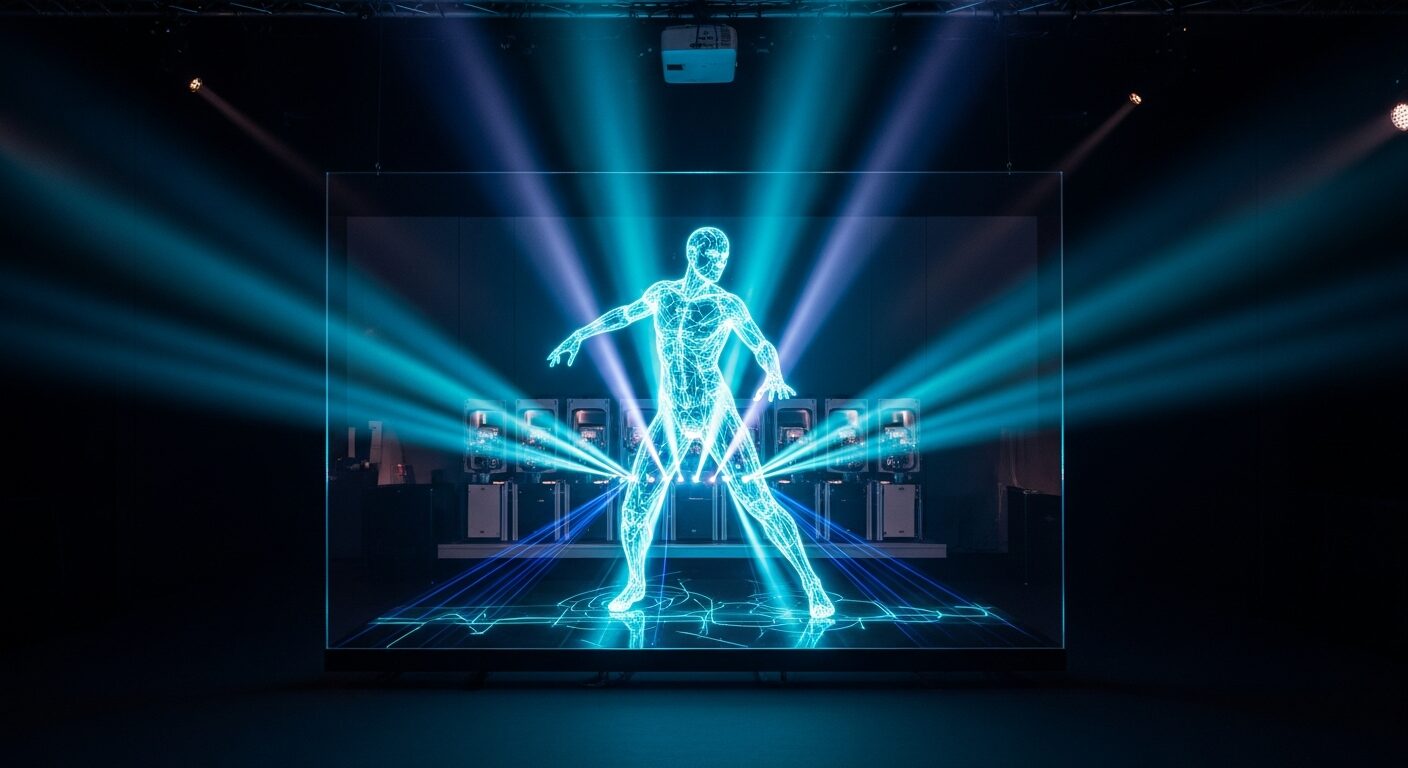
Most commercial holographic projection systems work on one of several core principles. The most widely deployed technique is the Pepper's Ghost method, where a high-brightness projector or LED display sends imagery onto an angled transparent surface — typically glass, acrylic, or holographic film — positioned at a precise angle to the viewer. The transparent surface reflects the projected content while remaining visually transparent, creating the illusion that the imagery is floating in the space behind or in front of the surface.
More advanced 3D hologram projector systems use holographic gauze or mesh screens that are nearly invisible when unlit. Content projected onto these screens appears to exist in three-dimensional space within a physical environment. When combined with environmental lighting control, spatial audio, and set design, these systems create compelling holographic experiences that feel genuinely immersive.
Volumetric display systems represent the cutting edge of hologram display technology. These systems project light into a volume of space — using rotating screens, laser plasma, or acoustic levitation of particles — to create true three-dimensional imagery that can be viewed from any angle without special glasses. While still emerging, volumetric displays are increasingly used in high-impact installations for museums, research facilities, and premium experience centres.
Holographic fan displays, also known as hypervsn or similar trade names, use arrays of high-speed rotating LED blades that create persistent-of-vision 3D images in mid-air. These are commonly deployed in retail environments, trade shows, and event installations for eye-catching product displays and brand experiences.
Use Cases for Holographic Projection Systems
Holographic projection systems are deployed across a wide range of industries and applications. In museums and cultural institutions, hologram projectors bring historical figures to life, present fragile artefacts as interactive 3D displays, and create immersive exhibition environments that engage visitors of all ages. A hologram of a historical leader delivering a speech, for example, creates an emotional connection that text panels and video screens cannot match.
Corporate experience centres use holographic projection to present products, brand stories, and innovation narratives. A 3D hologram projector displaying a new product design in mid-air, allowing visitors to see it from multiple angles, creates a memorable presentation moment that drives engagement and recall.
Entertainment and tourism venues are deploying holographic projection at scale for concerts, theme park attractions, and immersive storytelling experiences. Hologram zoo installations use large-scale holographic projection to create ethical wildlife experiences where visitors encounter life-sized holographic animals in immersive digital environments.
Education and training environments use holographic displays to visualize complex data, anatomical models, engineering prototypes, and scientific phenomena in three dimensions — making abstract concepts tangible and enabling spatial understanding that flat screens cannot provide.
Advantages of Holographic Display Technology
Holographic display technology offers several distinct advantages over conventional display systems. The three-dimensional presentation of content creates significantly higher engagement, recall, and emotional impact compared to flat-screen displays. Studies consistently show that visitors spend more time with holographic exhibits, remember the content better, and rate the experience more positively.
Holographic installations also offer unique spatial design possibilities. Because the display medium is often transparent, holographic content can be integrated seamlessly into architectural environments, physical exhibits, and scenic design — rather than requiring dedicated screen real estate that interrupts the spatial flow.
Modern holographic projection systems are also highly maintainable. Content updates can be deployed remotely without physical hardware changes, allowing institutions to refresh their holographic experiences seasonally, for special events, or in response to new acquisitions and narratives.
Vision3D's Approach to Holographic Installations
At Vision3D, we don't simply install hologram projectors — we design complete holographic experiences. Every installation begins with understanding the space, the audience, and the story that needs to be told. We then select and integrate the appropriate holographic display technology into a comprehensive experience design that includes spatial storytelling, interactive elements, environmental design, and content creation.
Our holographic installations include hologram wall storyscapes, interactive hologram floor displays, holographic stages for digital presenters, and complete immersive projection environments that combine holographic elements with 360-degree spatial content.
Explore our full range of capabilities or start a conversation about your next holographic installation.