
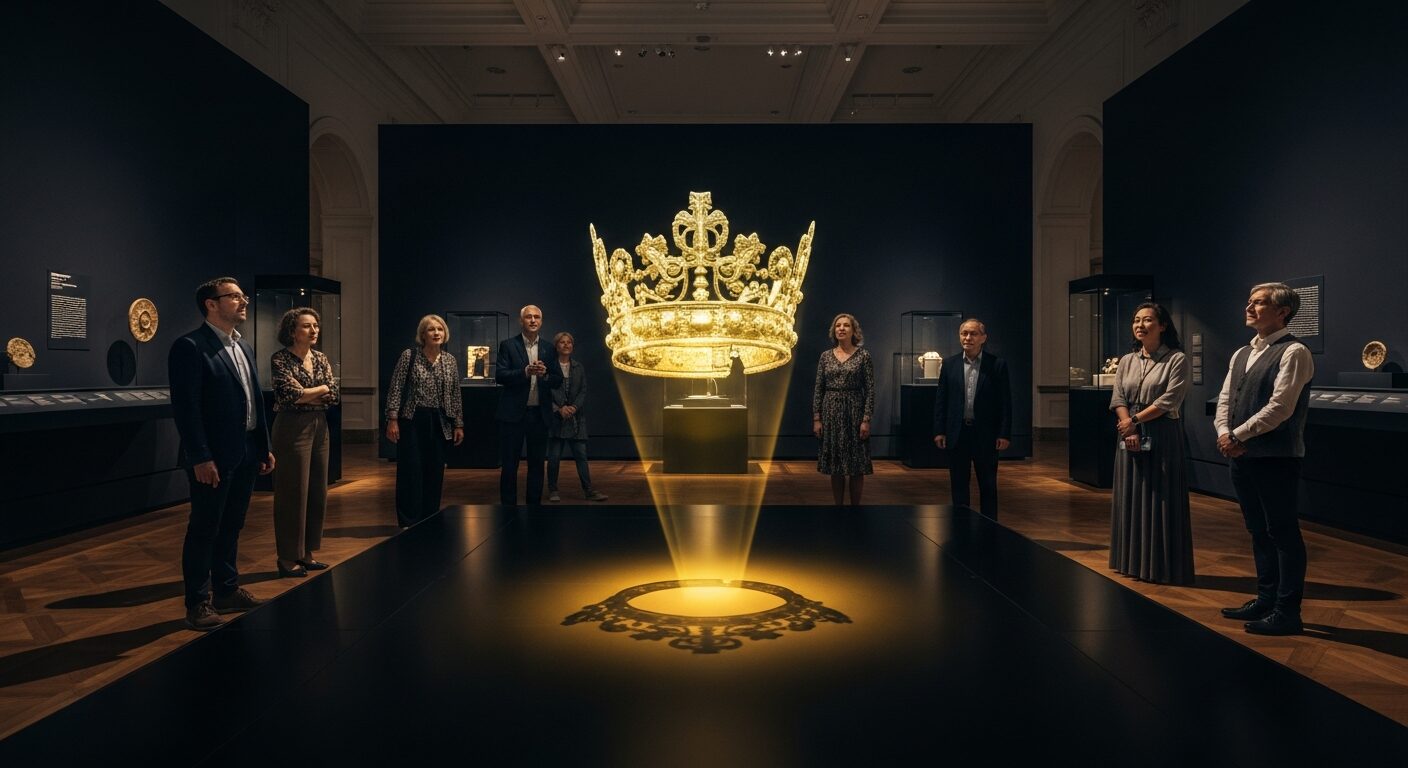
Hologram Technology in Museums
Hologram museum installations represent one of the most impactful applications of holographic display technology. Museums face a fundamental challenge: making static objects, historical events, and cultural narratives feel alive and relevant to modern audiences who are accustomed to rich digital media. Holographic displays solve this challenge by adding depth, movement, and spatial presence to museum content — transforming passive exhibit viewing into immersive cultural experiences.
Modern museum holographic installations range from individual artefact showcases that present objects as floating 3D holograms, to room-scale immersive exhibition environments where visitors are surrounded by holographic storytelling that brings historical periods, cultural traditions, and scientific concepts to life.
The key to successful hologram museum installations is not the technology itself, but how it serves the narrative. The best museum holograms enhance understanding, create emotional connections, and make cultural content accessible — rather than serving as standalone technology demonstrations. Vision3D designs museum holographic experiences with this principle at the core.
Applications of Holograms in Cultural Spaces
Artefact Presentation: Fragile, rare, or inaccessible artefacts can be presented as interactive 3D holograms that visitors can examine from multiple angles. A holographic display of an ancient manuscript, a delicate sculpture, or a complex mechanical device allows visitors to explore details that would be impossible to see behind glass cases — rotating the object, zooming into details, and viewing internal structures.
Historical Figure Presentations: Holographic stages bring historical figures to life as life-sized digital personas. A holographic Gandhi delivering a speech, a holographic Leonardo da Vinci explaining an invention, or a holographic queen addressing her court creates an emotional and educational impact that text panels and audio guides cannot approach.
Immersive Exhibition Environments: Hologram wall installations and hologram floor displays transform entire gallery spaces into immersive environments. Visitors walk through holographic recreations of ancient cities, natural environments, or significant historical events — experiencing cultural content spatially rather than through flat media.
Interactive Knowledge Exploration: Touch-responsive and gesture-controlled holographic displays allow visitors to explore museum content at their own pace and depth. A holographic timeline that visitors can navigate by gesture, a holographic map that reveals historical layers when touched, or an interactive holographic model that visitors can disassemble and examine — these experiences transform passive exhibit viewing into active exploration.
Advantages for Museums and Heritage Sites
Holographic exhibition displays offer museums several advantages that address long-standing challenges. Visitor engagement metrics consistently show that holographic exhibits attract significantly higher attention, longer dwell times, and better recall compared to traditional panel-based displays. In an era of declining museum attendance among younger demographics, holographic installations create the immersive, interactive experiences that modern audiences expect.
Preservation benefits are substantial. Holographic presentation of fragile artefacts eliminates the risk of physical damage from vibration, light exposure, and environmental conditions while giving visitors a more detailed view than any glass-case display could provide. Original artefacts can be stored in optimal conservation conditions while high-fidelity holograms serve the public display function.
Content flexibility allows museums to rotate exhibitions, update narratives, and respond to current events without physical exhibit fabrication. A holographic exhibition can be completely refreshed through content updates alone — new stories, new artefacts, new perspectives — keeping the museum experience relevant and encouraging repeat visits.
Accessibility improvements make museum content available to visitors with mobility, visual, or cognitive challenges. Holographic displays can be positioned at accessible heights, include audio descriptions, offer multiple language options, and present content at adjustable complexity levels — making cultural experiences genuinely inclusive.
Vision3D Museum Installations
Vision3D designs holographic museum installations as part of our immersive environment capabilities. Our museum projects span holographic artefact showcases, digital persona presentations on holographic stages, immersive exhibition environments, and interactive knowledge platforms — all designed to serve the museum's educational mission while creating memorable visitor experiences.
Our approach to museum holographic design begins with understanding the cultural narrative, audience needs, and institutional objectives. We then design holographic experiences that enhance understanding and emotional connection — using holographic projection technology as a tool for storytelling rather than an end in itself.
Explore our Cultural & Heritage Environments solutions or contact us to discuss a holographic installation for your museum or cultural space.