
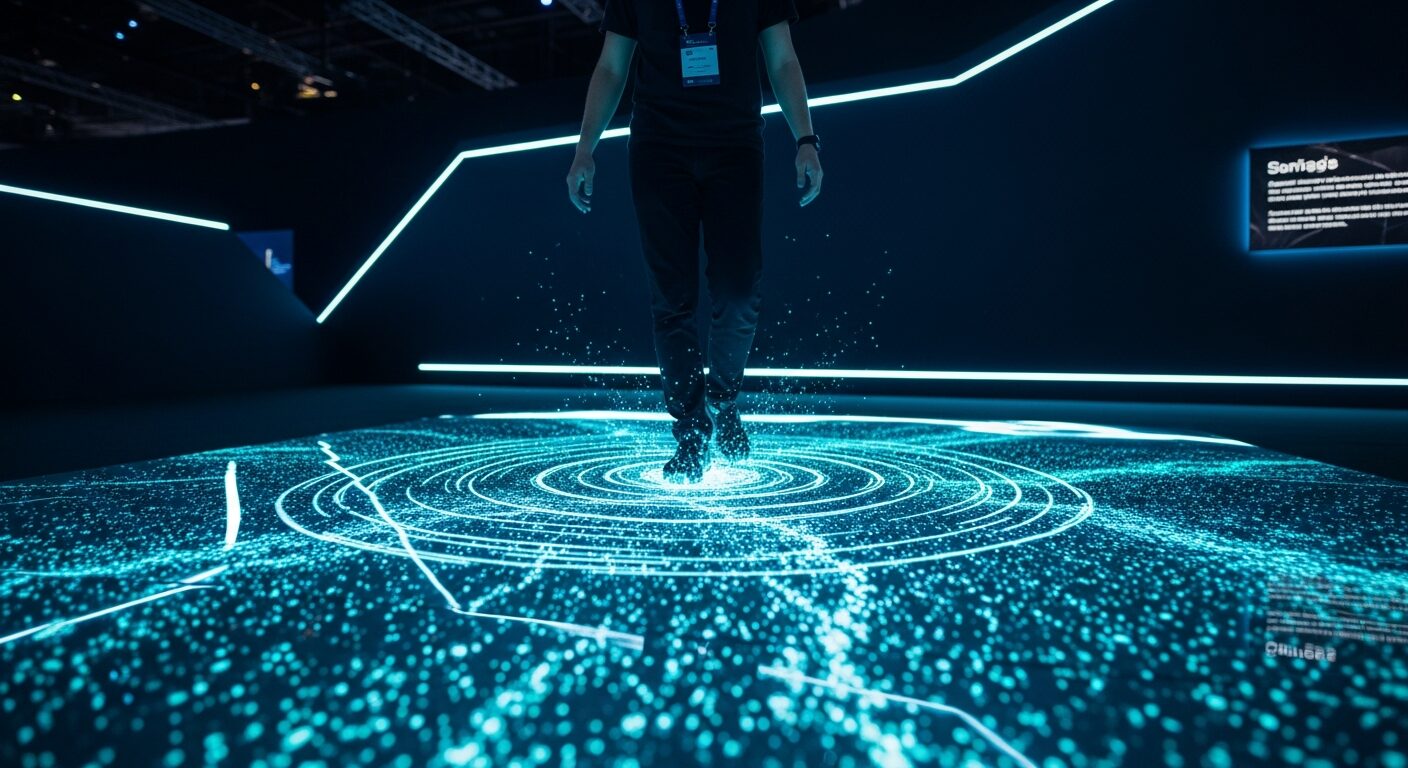
What is a Hologram Floor?
A hologram floor is an interactive display installation embedded in or projected onto a floor surface, creating three-dimensional visual content that visitors can walk over, interact with, and experience from above. These installations use projection mapping, LED floor panels, or transparent display surfaces combined with motion sensors and depth cameras to create responsive environments that react to visitor presence and movement.
Hologram floor displays are a key element of immersive environment design, particularly in museums, experience centres, and public installations where full spatial immersion — including the floor plane — creates a more complete and engaging visitor experience. When combined with hologram wall installations and ceiling projection, hologram floors contribute to 360-degree immersive environments where digital content surrounds visitors from every direction.
How Interactive Hologram Floors Work
Interactive hologram floor installations combine high-resolution visual display with real-time motion tracking. Overhead projectors or embedded LED panels display digital content across the floor surface, while infrared sensors, depth cameras, or pressure-sensitive surfaces detect visitor position, movement speed, direction, and gestures.
The tracking data feeds into a real-time rendering engine that modifies the visual content based on visitor behaviour. Fish scatter when walked over, water ripples spread from footsteps, flowers bloom where visitors pause, pathways illuminate to guide navigation, and interactive games respond to group movement. The content can range from naturalistic environmental simulations to abstract data visualizations to narrative-driven story sequences.
High-end hologram floor installations use multi-projector setups with edge-blending and geometric correction to cover large floor areas seamlessly. The projection is calibrated to maintain consistent brightness and colour across the entire surface, ensuring that the holographic content appears uniform regardless of viewing position.
Use Cases for Hologram Floor Installations
Museums and Exhibitions: Hologram floors create immersive exhibition environments where visitors walk through historical landscapes, oceanic environments, or archaeological sites. A museum gallery with a holographic floor displaying a flowing river, an ancient city map, or a geological cross-section adds a dimension of immersion that wall-mounted displays cannot provide.
Experience Centres: Corporate and institutional experience centres use hologram floors as part of immersive brand environments. Visitors walking into a room where the floor transforms beneath them — displaying product ecosystems, data visualizations, or brand worlds — creates a memorable first impression.
Cultural and Sacred Spaces: Hologram floor installations in temples, heritage sites, and cultural centres create reverent, immersive environments where visitors can walk through digital recreations of historical events, sacred narratives, or cultural journeys.
Children's Museums and Education: Interactive hologram floors are particularly effective in educational environments, where children can learn through movement and play. Walking through a projected solar system, interacting with marine life, or exploring geographical features through floor-based interaction creates kinaesthetic learning experiences that improve engagement and retention.
Tourism and Entertainment: Hologram zoo attractions and tourism installations use floor displays to create environments where visitors walk through holographic landscapes, underwater worlds, and fantasy environments that extend the immersive experience to every surface.
Advantages of Holographic Floor Displays
Interactive hologram floors offer several distinct advantages for immersive environment design. The floor plane is an underutilized surface in most installations — activating it with interactive holographic content dramatically increases the sense of spatial immersion and transforms passive walkways into active experience zones.
The interactive element drives significantly higher engagement than passive displays. Visitors instinctively respond to floor-based content — stepping, pausing, and playing with the responsive visuals. This creates organic dwell time and natural engagement without requiring explicit instructions or guided interaction.
Hologram floor installations are also highly adaptable. Content can be changed remotely to support different exhibitions, seasonal themes, special events, or audience segments without any physical modification to the installation. This flexibility makes them particularly valuable for institutions that rotate content regularly.
Vision3D Hologram Floor Experiences
Vision3D designs hologram floor displays as part of our Immersive Environments capability. Our 3D Hologram Floor Experiences combine high-resolution projection, real-time motion tracking, and purpose-built interactive content to create floor environments that respond to every visitor.
Our hologram floor installations are integrated into complete immersive environments alongside hologram wall storyscapes, spatial audio, environmental lighting, and interactive visitor experiences — creating 360-degree digital environments where every surface tells part of the story.
Contact us to discuss a hologram floor installation for your museum, experience centre, or visitor environment.