
Hologram Technology
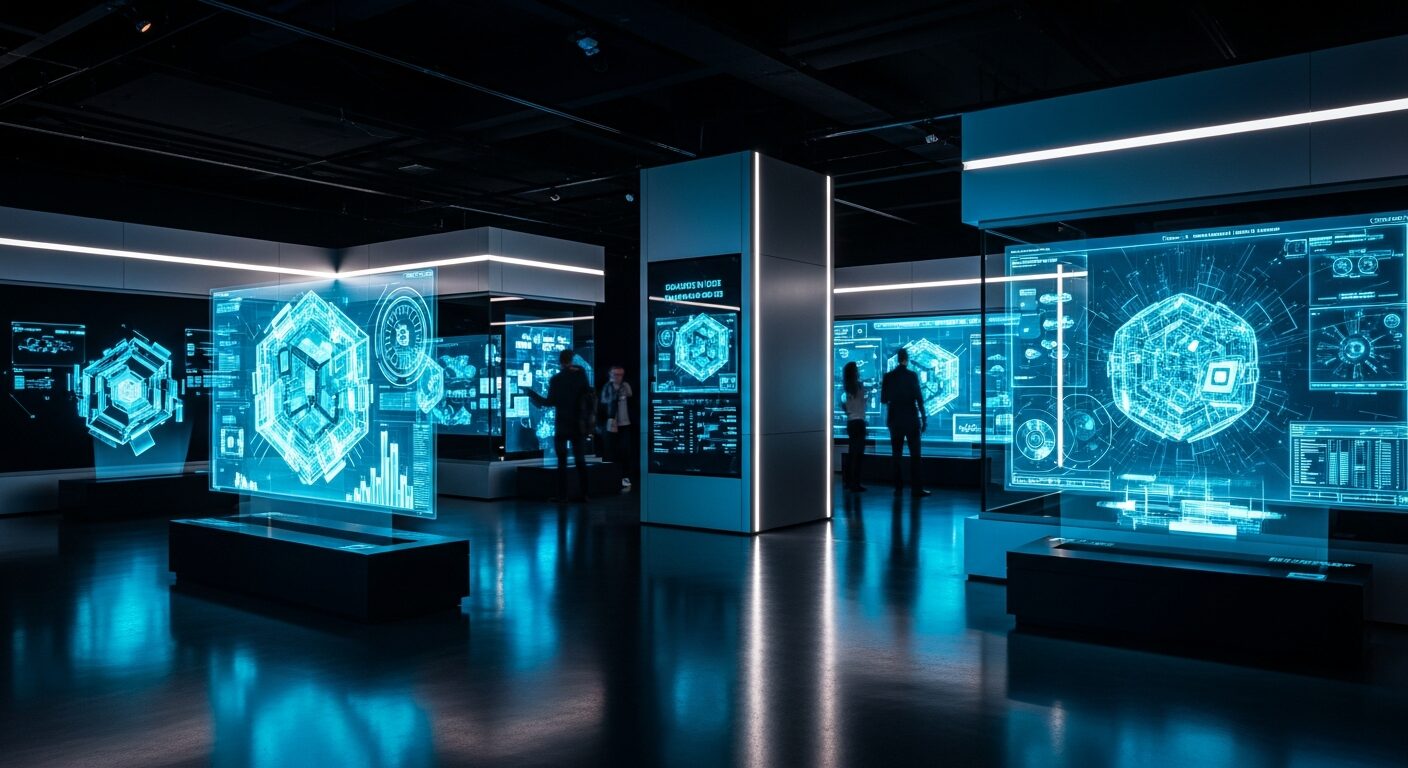
Hologram technology is transforming how people experience physical spaces. From museums and experience centres to public attractions and corporate environments, holographic displays create immersive digital environments that captivate audiences and communicate complex narratives through spatial storytelling.
How Holographic Displays Work
Holographic projection systems work by projecting high-resolution content onto specialized surfaces — transparent screens, angled glass, holographic gauze, or directly into volumetric space. The projected imagery is precisely calibrated to create depth illusions that appear to float in mid-air or emerge from physical environments.
Advanced systems combine multiple projection sources, spatial audio, environmental lighting control, and motion sensors to create fully immersive holographic environments where visitors are surrounded by digital content that responds to their presence and movement.
Vision3D designs and deploys holographic installations that go beyond simple display technology — creating complete immersive experiences where the holographic content is integrated into a spatial narrative, environmental design, and interactive storytelling framework.
Types of Hologram Systems
Pepper's Ghost Displays
Using angled glass or film to reflect projected images, creating the illusion of floating 3D objects in physical space.
Holographic Fan Displays
High-speed rotating LED arrays that render 3D visuals in mid-air, commonly used for retail and event installations.
Volumetric Displays
True three-dimensional displays that project light into a volume of space, viewable from multiple angles without special glasses.
Holographic Projection Environments
Large-scale projection-mapped environments using transparent screens, gauze, and spatial audio to create fully immersive holographic spaces.
Hologram Stages
Performance-grade holographic platforms that present life-sized digital personas, speakers, and characters in physical environments.
Interactive Holographic Surfaces
Touch-sensitive and motion-responsive holographic walls and floors that react to visitor behaviour in real time.
Where Hologram Installations Are Used
Holographic technology is deployed across a wide range of industries and environments. From world-class museums preserving cultural heritage through holographic artefact displays, to corporate experience centres using hologram walls for brand storytelling, to tourism attractions creating hologram zoo experiences — the applications are expanding rapidly as the technology matures and becomes more accessible.
Museums and Cultural Institutions use holographic displays to bring historical figures to life, present fragile artefacts as interactive 3D holograms, and create immersive exhibition environments that engage visitors of all ages.
Read Full ArticleCorporate Experience Centres deploy hologram walls and holographic stages to present products, brand narratives, and innovation stories in ways that leave lasting impressions on visitors and stakeholders.
Read Full ArticleTourism and Entertainment venues are adopting hologram zoo concepts and immersive holographic attractions that offer ethical wildlife experiences, historical recreations, and fantasy environments without physical infrastructure limitations.
Read Full ArticleEducation and Research environments use holographic visualization for anatomy, engineering, archaeology, and scientific data — making abstract concepts tangible and explorable in three dimensions.
The Future of Holographic Experiences
Holographic technology is evolving rapidly. Advances in spatial computing, real-time rendering, AI-driven content generation, and transparent display materials are making holographic installations more immersive, interactive, and accessible than ever before.
The next generation of holographic experiences will blur the line between physical and digital environments entirely — creating spaces where holographic content is indistinguishable from physical objects, responsive to individual visitors, and capable of delivering personalized narratives at scale.
Vision3D is at the forefront of this evolution, designing immersive holographic environments that combine cutting-edge display technology with experience design, spatial storytelling, and interactive digital content to create the next generation of spatial experiences.
Explore Hologram Topics
Design Your Holographic Experience
Vision3D designs and deploys hologram walls, hologram floors, holographic stages, and complete immersive holographic environments. Tell us about your space.
Start a Conversation